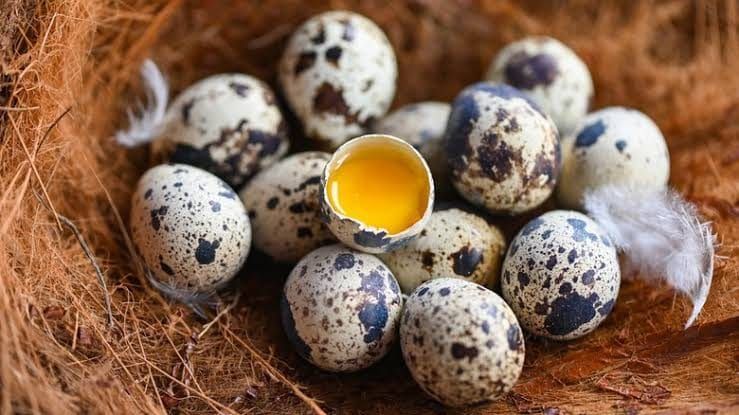
They're tiny (9–12 g, roughly a fifth of a chicken egg), speckled in patterns unique to each hen, and disproportionately rich in yolk. The hens that lay them start at 6–8 weeks old and commonly produce 200–300 eggs a year.
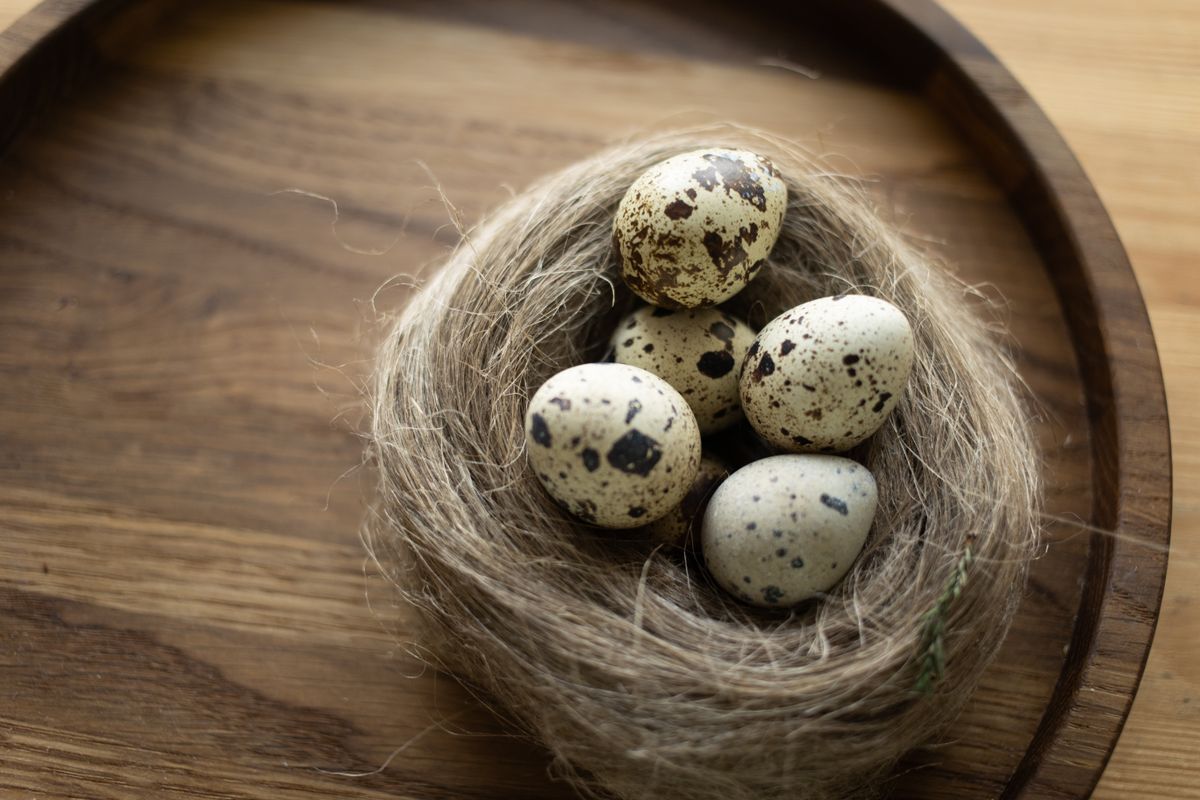
A quail egg weighs nine to twelve grams, about a fifth of a chicken egg and the size of a large olive. Each wears a speckle pattern unique to the hen that laid it: brown splotches over cream, occasionally powder-blue in celadon lines. Quail eggs generally aren't sold in graded size classes the way chicken eggs are; a carton of quail eggs is a carton of near-identical miniatures.
What they lack in volume they compensate for in concentration: proportionally more yolk than a chicken egg, which is why cooks describe them as richer, and why they behave beautifully in baking despite the fiddly arithmetic (three to five per chicken egg, the conversion page has the working rules). One egg runs about 14 calories with a bit over a gram of protein, per USDA figures; the full nutrient picture, laid out beside the chicken egg's, lives on the comparison page.
The hens are the real story. A Coturnix hen lays her first egg at six to eight weeks old and settles into near-daily lay, commonly 200–300 eggs a year, with about 200 a typical first-year count. The production biology, the light requirement, and the curve over a hen's life are on the production page.
In the kitchen, everything you'd do to a chicken egg works in miniature and in fast-forward: a hard boil takes minutes, not double digits, and the classic preservation, pickling, is where quail eggs outclass their bigger cousins, being bite-sized by design. (Pickled eggs are refrigerator products, full stop; the safety authorities are unambiguous, and that page explains why.)
Work the five sections in order, or jump to the one that brought you here.
FAQ
Where do you even buy quail eggs?
Farmers markets, Asian groceries, more supermarkets every year. Or skip the shopping entirely: six hens, ten weeks, and you're the supplier.
Do they taste different from chicken eggs?
Remarkably similar, richer if anything, given the yolk share. The differences are texture and experience, not flavor chemistry.
Why are they speckled?
Pigment deposited on the shell as it forms. Each hen's pattern is consistent and individual, which makes the speckles a genuine identification feature.