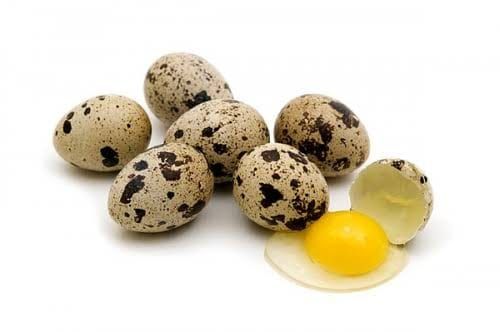
Three to five, depending on sizes — the working rule is 4 standard quail eggs per large chicken egg (3 if they're jumbo quail eggs). By weight: about 50 g of quail egg per large chicken egg.
Two questions live under this search: the substitution question and the nutrition question. Both have honest answers; neither needs hype.
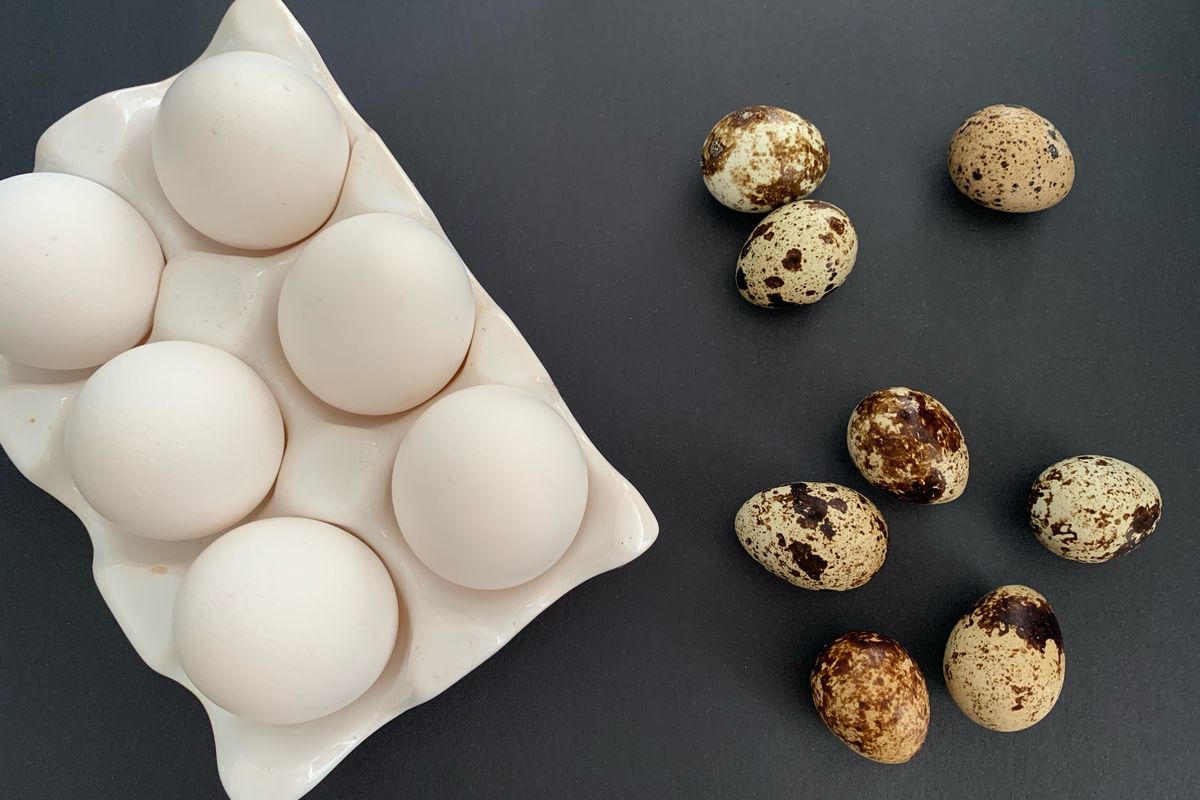
The substitution math
The spread across credible sources runs three to five quail eggs per chicken egg, and it's not disagreement so much as size classes doing what size classes do. The cleanest working rules: one large chicken egg = 4 standard quail eggs or 3 jumbo quail eggs; one extra-large chicken = 6 standard or 4 jumbo. Meyer Hatchery's kitchen equivalence agrees from the other direction: one chicken egg ≈ 60 grams ≈ ¼ cup of cracked quail egg ≈ 3–5 eggs.
For anything where egg quantity changes the outcome, baking especially, skip the counting and use the ¼-cup measure or a scale (about 50 g per large chicken egg). Quail eggs vary just enough that volume beats arithmetic; working keepers make the same point from experience.
Practical kitchen notes: quail shells are proportionally tougher, with a tough inner membrane. Cracking takes a deliberate motion or dedicated quail-egg scissors (a useful gadget, for once), and everything cooks in a fraction of chicken-egg time (the boiling schedule).
The nutrition table
Per equal weight (100 g, roughly 10 quail eggs vs 2 large chicken eggs), from USDA FoodData Central:
| Per 100 g | Quail eggs (~10) | Chicken eggs (~2 large) |
|---|---|---|
| Calories | 158 | 143 |
| Protein | 13.0 g | 12.6 g |
| Fat | 11.1 g | 9.5 g |
| Riboflavin (B2) | 0.79 mg (61% DV) | 0.46 mg (35% DV) |
| Vitamin B12 | 1.58 µg (66% DV) | 0.89 µg (37% DV) |
| Iron | 3.65 mg (20% DV) | 1.75 mg (10% DV) |
| Choline | 263 mg (48% DV) | 294 mg (53% DV) |
Read plainly: per weight, quail eggs carry slightly more protein and fat, roughly double the iron, and about three-quarters more riboflavin and B12. Chicken eggs carry more choline. Per egg, of course, a 9-gram quail egg contains about a fifth of everything a 50-gram chicken egg does; the differences above only matter if you're eating equivalent amounts.
The table describes composition. It makes no health claims, and neither do we; what the numbers mean for any particular diet is a question for your own reading.
So which egg?
Kitchen logistics: chicken, no contest, one crack per pancake. Presentation, snacking, pickling, garnish: quail, no contest; bite-sized is the feature. Producing your own in a small space: that's a different comparison entirely, and quail make a strong case.
FAQ
Can I substitute quail eggs in any recipe?
Yes; bakers report clean results across icings, doughs, and cakes at correct volume. The limit is patience, not chemistry.
Are the shells different colors inside?
The speckles are surface deposit; underneath, shells are white-to-pale (blue in celadon lines). Rub a fresh speckle and it can smudge, normal, not dirt.
Why are quail eggs more expensive per gram?
Small eggs, small industry, hand-scale packing. Quail eggs sit outside the commodity infrastructure that keeps chicken eggs cheap, another argument for six hens.