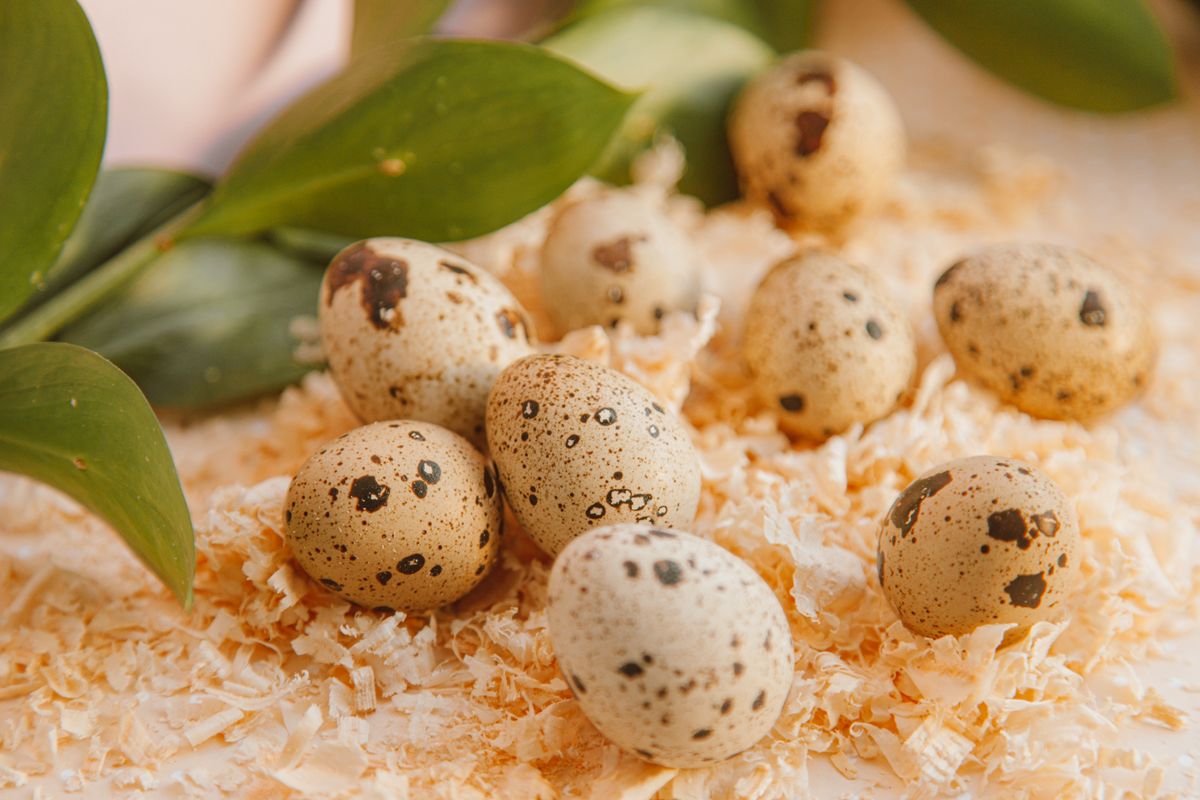
Coturnix carrying two copies of the recessive celadon (ce) gene, which turns their eggshells blue — icy to robin's-egg to greenish, plain or speckled. It's an egg-color gene, not a variety: it appears under any feather color.
The mechanism, cleanly: celadon is an autosomal recessive eggshell-color mutation, ce in the peer-reviewed literature, first described in Japanese quail in the Journal of Heredity. A hen needs two copies to lay blue; a bird with one copy is a carrier, externally ordinary, laying standard cream-and-speckle eggs while quietly holding half the recipe. Celadon layers aren't a separate variety of quail. Celadon is a trait some Coturnix carry.
The one fact worth memorizing: the gene has nothing to do with feathers. Feather color and egg color are genetically unrelated. Celadon can be bred into any line (Pharaoh, Tibetan, tuxedo, even jumbo, laboriously), and no bird's appearance reveals carrier status. A "celadon quail" is identified at the egg tray, never in the hand. Breeders would dearly love it otherwise.
The blues themselves run a real spectrum: washed icy blue through proper robin's-egg to distinctly greenish, plain-shelled or brown-speckled over blue. (Hatchery honesty note, via McMurray: typical celadon blue is a light blue, well short of the saturated turquoise in filtered photos.) The greenish end has a breeder-hypothesis explanation (a brown-pigment overlay on the blue base, chicken-olive-egg style) plausible, and presented here as breeder observation rather than settled science.
Buying and breeding, where the recessive math bites:
- Buying layers: "100% true blue" stock means both parents were verified blue-egg lines. Even then, breeder listings warn that a percentage of chicks from blue eggs grow up laying speckled eggs anyway (they carry the genetics; expression has edge cases). A reputable seller says this out loud; treat silence as information.
- Breeding forward: blue × blue breeds true (both parents are double-copy by definition). A blue hen under a non-celadon rooster produces all carriers and zero blue layers in the first generation, the classic new-breeder heartbreak, and pure Mendel. Keep celadon pens genetically closed or accept the project timeline.
- Husbandry: none of this changes a single care figure. Feed, housing, incubation, and production all run standard Coturnix; the gene colors the shell and stops there.
Why bother? Because a mixed tray of cream-speckled and celadon-blue quail eggs is legitimately one of the best-looking things a backyard produces, and for egg-selling keepers, the blues are the carton that markets itself.
FAQ
Are celadon eggs different inside, taste or nutrition?
No credible evidence of either; shell pigment is cosmetic. They're standard quail eggs in formalwear.
My celadon hen's eggs look green, is that wrong?
It's within the documented spectrum. If you want bluer, the breeder practice is selecting hatching eggs from the bluest layers.
Can I add celadon to my existing covey?
Add a true-blue pair and run them as a closed sub-pen; mixing into the general population dilutes the recessive into invisibility within a generation.